Fixed mast crane
Retail Price
Market price
Weight
Inventory
隐藏域元素占位
- Product Description
-
1. Overview
Freighters carrying liquefied gas, oil products and hazardous chemical media are usually loaded and unloaded through marine oil transfer arms. The marine oil transfer arm is fixed to the dockside, connected to the flange on the freighter through the three-dimensional joint at its front end, and connected to the pipeline flange of the liquid storage equipment on the dock through its bottom flange, thereby realizing the liquid loading and unloading process. This highlights its superiority for loading and unloading at large tonnage berths (more than 50,000 tons to 300,000 tons).
Similarly, the crane is fixed on the dockside, and the hose for conveying liquid medium is lifted. One end of the hose is connected to the cargo ship through the rotation and amplitude change of the boom, and the other end of the hose is connected to the conveying pipe network flange of the liquid storage equipment on the dock. Thus, the liquid loading and unloading process is realized. This highlights its superiority for the loading and unloading of small tonnage and multi-cargo berths.
With the deepening of my country's reform and opening up, the sustained economic development, and the rapid increase in demand for energy. my country's oil consumption has increased year by year, from 224 million tons in 2000 to 364 million tons in 2007, with an average annual growth of 7.2%. However, my country's oil production has remained at around 180 million tons. In 2007, China's crude oil production was 186.2 million tons, an increase of 1.43 million tons over the previous year, and the future production will remain at this level. Therefore, the gap between oil consumption and crude oil production is getting bigger and bigger, and this part of the difference must be made up by oil imports. In 2007, 196.8 million tons of oil were imported, including 163 million tons of crude oil and 33.8 million tons of refined oil. This has promoted the construction of oil and gas terminals in my country, thereby driving the development of loading and unloading equipment. Hose cranes, one of the loading and unloading equipment, also bring development opportunities.
Our company seized this opportunity and used the existing plant, equipment and human resources to rapidly develop crane products independently. Since the design and manufacture of the first crane product in 2005, a total of 28 sets have been produced so far. We have a deep understanding of the performance and use requirements of the product. The technical key and difficult points of the product have been well solved. The structure and performance of the product have been continuously improved and the quality has been continuously improved. At the same time, the company has also achieved good economic benefits.
As customers' requirements for ship types, media and lifting tonnage continue to change, especially the demand for lifting tonnage tends to increase.
2. Technical parameters
3. Performance and structural configuration
3.1 Overall Performance
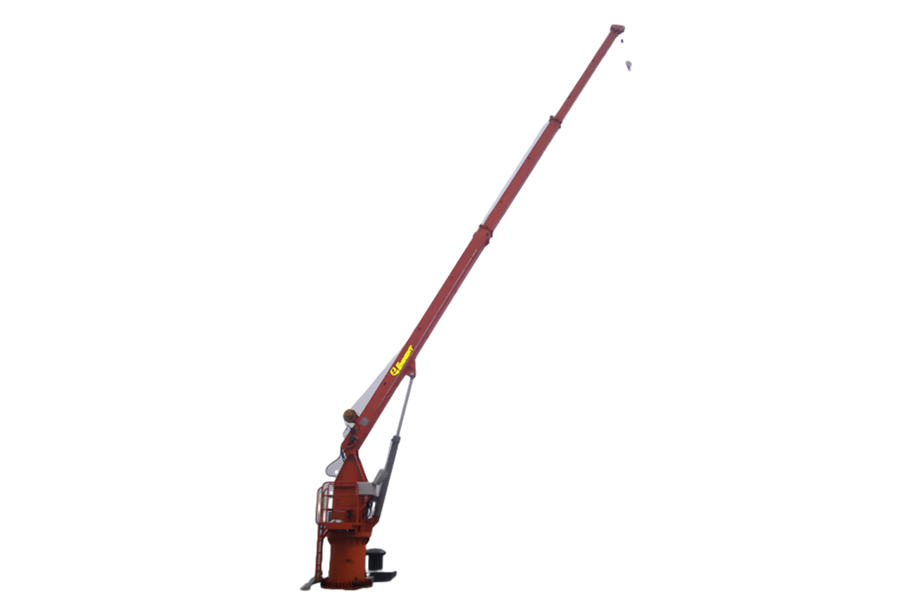
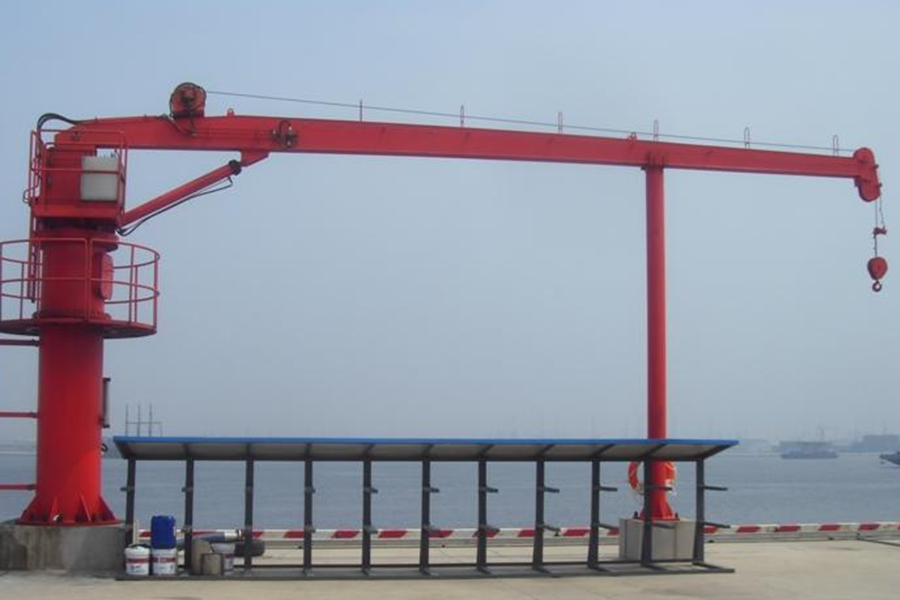
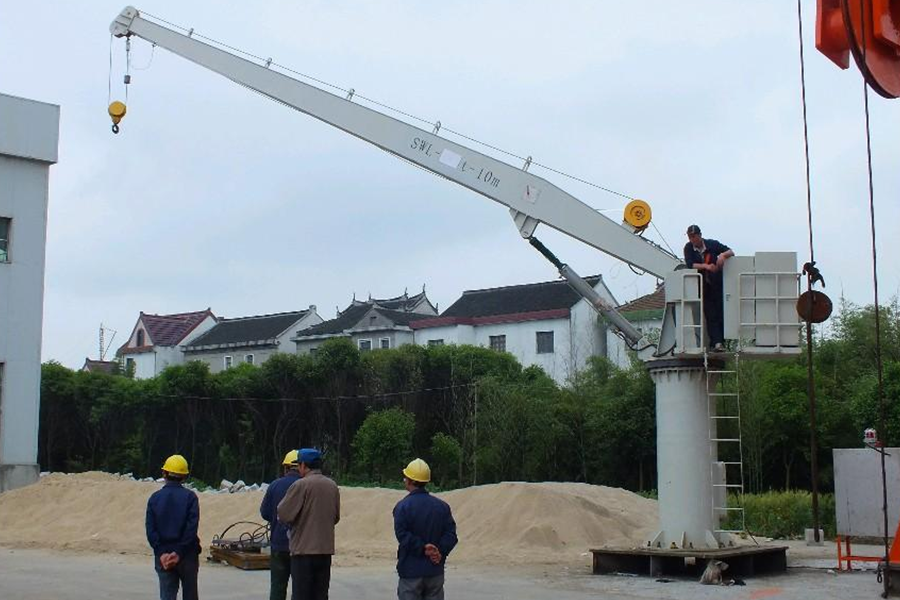
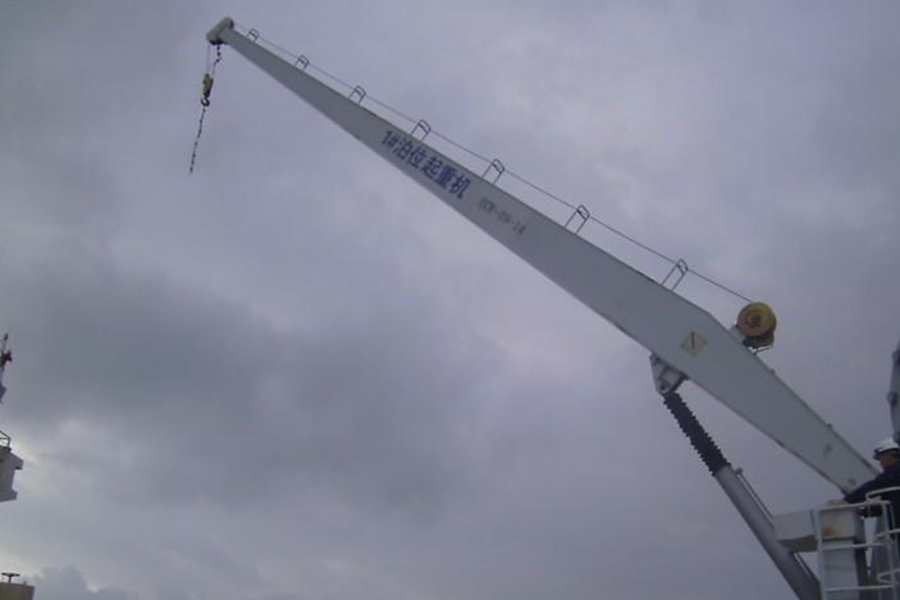
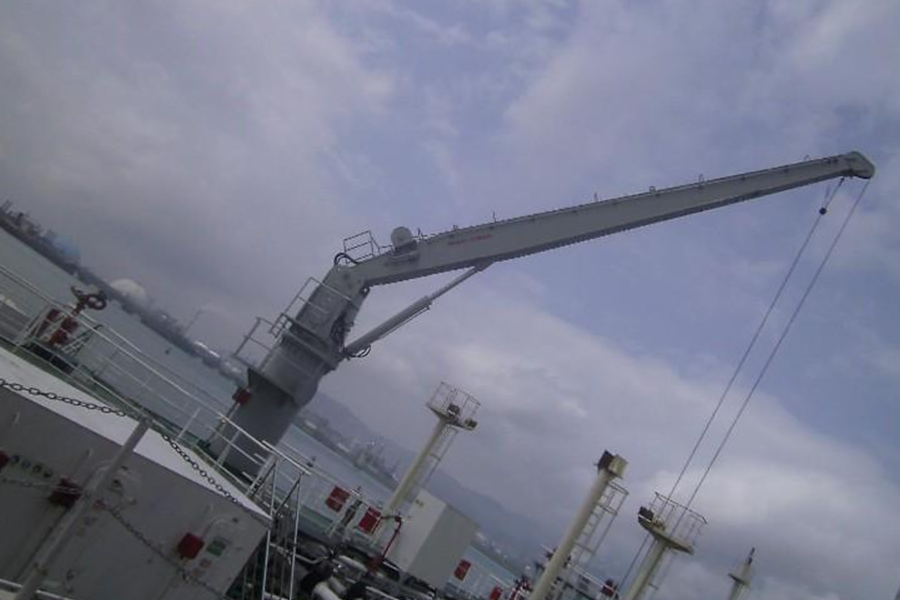
ECR series "Fixed Mast Crane" is suitable for lifting hoses, sundries, spare parts, etc. at ports and docks. It has compact structure, reliable performance, flexible operation and convenient maintenance.
The action of the fixed mast crane is performed by three major systems: hook lifting, boom luffing, and boom slewing. The speed of all actions is steplessly adjustable from zero to maximum. Each combination of two actions can work under rated load, but the speed is reduced accordingly.
3.2 Overall structure
It is mainly composed of five parts: column, rotating column, boom, hydraulic system and electrical control system.
The rotating column and the column are connected by an internal gear type slewing bearing, and the boom and the rotating column are hinged by a pin shaft.
The hydraulic system and electrical control system are installed on the slewing mechanism operating platform, and are equipped with two operating modes: local control buttons and remote control.
3.3 Actuator
It is mainly divided into three parts: hydraulic winch lifting mechanism, luffing and pitching cylinder and hydraulic slewing device.
The lifting mechanism consists of a hydraulic motor, a built-in planetary gear reducer, a drum, a hydraulically controlled disc brake, a wire rope, and a hook pulley to achieve the up and down movement of the goods.
The luffing cylinder is used to change the working range of the crane.
The hydraulic slewing device consists of a hydraulic motor, a planetary gear reducer, a pinion and a hydraulically controlled disc brake to realize the left and right rotation of the crane.
3.4 Hydraulic system
The hydraulic system is the power supply device of the column jib crane. When in standby mode, the unloading solenoid valve is in the on state and the system automatically unloads. The lifting mechanism, luffing cylinder and slewing device are respectively controlled by three groups of electromagnetic reversing valves and are equipped with a speed regulating valve to steplessly adjust the speed of each action.
3.5 Electrical system
3.5.1 Automatic control: The electrical control system is installed on the rotary operating platform. The electrical control system is equipped with local control buttons, which can move in six directions. At the same time, for the convenience of operation, a wireless remote control system is provided, which can be operated within a range of 0~100 meters by holding a remote control transmitter.
3.5.2 Manual control: Power switch button box, start power button, manually operate the manual valve stem for operation.
3.6 Security Protection
Includes actuators, moving parts, hydraulic system, electrical protection and emergency release.
● Executing agency:
The upper limit of the hook of the hoisting winch is composed of a reversing limit valve mechanism. When it reaches the upper limit, the electrical control system controls the hydraulic winch to stop the lifting action;
The boom luffing cylinder extends and retracts, and when the cylinder stroke reaches the limit position, the oil pressure unloads for protection;
The crane overload protection is provided by hydraulic unloading;
The limit of the slewing mechanism is controlled by mechanical limit and hydraulic unloading protection.
● Moving parts: The lifting wire rope is galvanized and non-rotating, and the minimum safety factor meets the specifications.
● Electrical protection: The motor is equipped with overload protection and overheat protection.
● Emergency release: Portable manual pump can realize emergency lowering of cargo and emergency rotation of crane. Emergency lowering of boom can be realized by adjusting the pressure of balance valve.
4. Operation procedures and precautions
4.1 Operating procedures
Climb onto the operating platform, turn on the control power, start the motor, operate the buttons, perform various required actions, and adjust the movement speed to an appropriate state.
4.2 Limit protection
4.2.1 When the lifting hook reaches the upper limit, it is protected by the limit reversing valve and the lifting hook stops moving. At this time, the lifting hook cannot rise but can only fall.
4.2.2 When the slewing mechanism reaches the mechanical limit, the oil pressure unloads and the slewing stops.
5. Maintenance
5.1 The movable parts (hooks, shackles, rings, pulleys) should be inspected externally by the operating personnel regularly (not more than three months) and at least once an annual inspection should be carried out every 12 months.
5.2 Check the limit switch control frequently to see if it is in good working condition.
5.3 Check the hydraulic system regularly to see if it is clean and ensure that the connections are well sealed.
5.4 Recommended lubricants:
Hydraulic system oil: 160 liters Anti-wear hydraulic oil: South of the Yangtze River: (L-HM46#); North of the Yangtze River: (L-HV40#)
Hoisting winch: 2.8 liters Anti-wear hydraulic oil: South of the Yangtze River: (L-HM46#): North of the Yangtze River: (L-HV40#)
Swing gearbox: 3.5 liters Anti-wear hydraulic oil: South of the Yangtze River: (L-HM46#): North of the Yangtze River: (L-HV40#)
5.5 The steel wire rope should be inspected externally regularly (no more than three months). If the steel wire rope is found to be excessively worn, severely corroded, or more than 5% of the steel wires are broken within a length range of 10 times the diameter, it must be replaced. (Note: The galvanized steel wire rope model is 6*19+FC, φ8, and 50 meters in length)
5.5 All rotating parts on the structure should be lubricated regularly.
5.6 After installation and after a period of use, the paint of all parts and components must be checked. If any damage or peeling is found, it should be repaired.
5.7 Check or adjust the hoisting winch and slewing mechanism brakes every 1000 hours. It is recommended to replace the brake pads every 3000 hours. Check the tightening torque of the hoisting winch and slewing mechanism bolts and nuts every 500 hours.
5.8 The whole machine should be inspected once a year and a lifting test should be carried out every four years in accordance with the specifications.
6. Equipment related photos

Previous Page
Next Page
Contact Us
Address: 2000 Weiqing East Road, Jinshan District, Shanghai
Telephone: 86 21 57941569 86 13917958831
Fax: 86 21 57262601
E-mail:info@china-eminent.com
Social Media


Friendship Link